
[HubSpot]
Breeze: what HubSpot's agentic AI changes for your teams

Reading time: 5min
24.06.2026

AI in the CRM is not new. Predictive scoring, content suggestions and call transcription have existed for years in most platforms. What changes with Breeze is the nature of the intervention: we move from AI that suggests to AI that executes. A Breeze agent does not just recommend a reply to a ticket; it writes it, documents it and can resolve it on its own within the scope you have defined.
This shift, from assistance to agentic AI, raises a question vendors' communication rarely addresses: what do you need to have built in your HubSpot portal for these agents to produce reliable work? Our conviction, formed through our deployment and audit projects, fits in one sentence: AI amplifies what already exists. On a clean base with documented processes, it multiplies teams' capacity. On disorganized data, it reproduces errors at scale.
This article is for marketing, sales and RevOps leaders who want to understand what HubSpot Breeze actually covers, what agentic AI changes in their teams' daily work, and where to start without taking risks.
Breeze is not one product, it is three distinct layers
The confusion is common: Breeze is often presented as “HubSpot's AI”, in the singular. In reality, the term covers three building blocks with very different logics, and the distinction directly shapes your deployment choices.
Breeze Copilot, renamed Breeze Assistant by HubSpot, is the conversational assistant built into the portal. It answers users' questions, summarizes a company record before a meeting, drafts an email or prepares meeting notes. It is the simplest layer to activate: it assists a human who remains the one who executes and decides.
Breeze agents are the agentic layer proper. An agent handles a mission end to end: prospecting target accounts, answering visitors' and customers' questions, producing content. The human defines the framework, validates or supervises, but no longer executes each step. This is where the real change happens, and it is also where the prerequisites are most demanding.
Breeze Intelligence is the data layer: enrichment of contact and company records, detection of buying intent, shorter forms thanks to data already known. Less spectacular than agents, it is often the best entry point, because it improves the raw material everything else depends on.
Keeping this three-layer architecture in mind avoids the classic mistake: activating an ambitious agent on data that Breeze Intelligence has not yet consolidated.
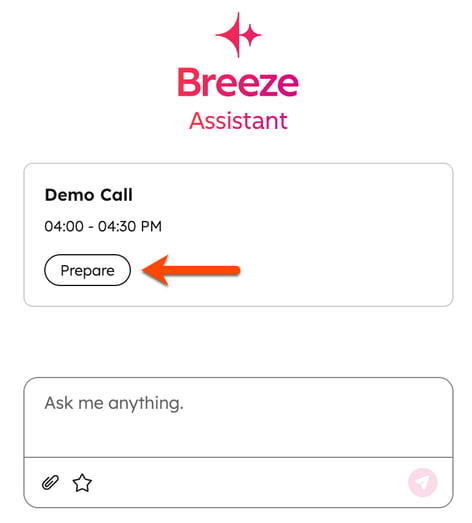
Breeze Assistant prepares a meeting from the CRM context (source: HubSpot).
What agentic AI changes in practice, team by team
For sales teams: prospecting runs in the background
Sales preparation work (identifying the right accounts, researching context, personalizing a first approach) takes up a large share of SDRs' and sales reps' time. A prospecting agent takes over this work: it monitors buying signals, qualifies the accounts in your database according to your criteria and prepares or initiates the first interactions. Let us be precise about the scope, because the confusion is common: by default, the agent works on the contacts and companies in your CRM; sourcing entirely new contacts requires connecting a third-party data provider such as ZoomInfo, Apollo or Surfe.
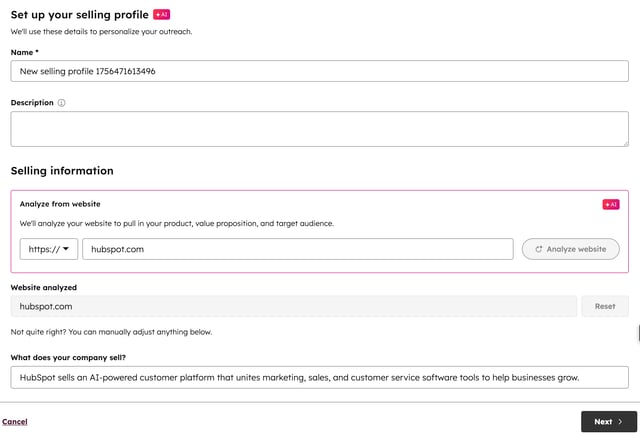
The prospecting agent relies on a formalized sales profile: value proposition, targets, outreach rules (source: HubSpot).
The change is not that sales reps prospect faster. It is that their role shifts toward what an agent does not do: high-stakes conversations, negotiation, relationship building. In return, this requires your targeting to be formalized. An agent does not guess your ICP: if your qualification criteria live in your sales director's head, they must first be translated into properties and segments in the CRM.
For customer service: first-level requests are resolved without a queue
The service agent answers recurring requests using your knowledge base and the CRM context of the customer who is writing. Simple requests are resolved immediately, complex cases are passed on to a human with the history already compiled.
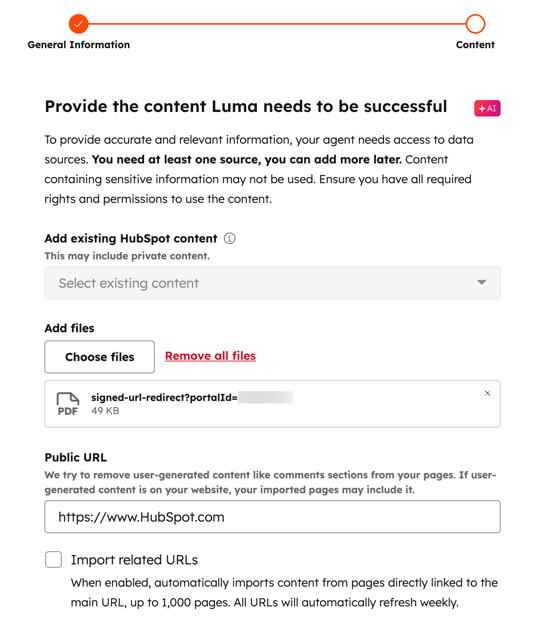
The Customer Agent answers only from the content sources you provide: their quality determines its quality (source: HubSpot).
The implication for your support teams: their value is concentrated on difficult cases and relationships, and the quality of your documentation becomes a production asset. An outdated knowledge base, which used to be an internal irritant, becomes the source of wrong answers sent to your customers. Bringing it up to date is a prerequisite, not an option.
For marketing: production speeds up, framing becomes the job
On the content side, the agent produces briefs, adaptations and variants at a pace no team can match manually. The consequence is counterintuitive: the more production is automated, the more value shifts upstream (editorial strategy, the angle, the proprietary data that makes content impossible to imitate) and downstream (validation, brand consistency). The marketing automation teams that benefit from Breeze are not the ones that produce more, but the ones that have defined what deserves to be produced.
The prerequisite nobody wants to hear about: data
Everything above rests on a silent assumption: that your HubSpot portal contains reliable, structured and governed data. This is the assumption that most often turns out to be false.
A prospecting agent working on a database full of duplicates contacts the same accounts twice. A service agent reading incomplete records gives off-target answers. A copilot summarizing a poorly documented history produces a wrong summary with complete confidence. The mechanism is always the same: AI does not check the data, it consumes it.
Before activating any agent, three areas deserve an honest assessment:
The data model. Do your objects, properties and associations really reflect your processes? Agents reason on this structure. A poorly defined lifecycle or ambiguous pipeline stages will produce equally ambiguous agentic decisions.
Quality and completeness. Duplicate rate, empty critical fields, inconsistent formats: these measurable indicators directly determine the error rate of your future agents.
Governance. Who is allowed to create properties, modify workflows, validate an agent's actions? Agentic AI without governance is like hiring a very productive employee without giving them a manager.
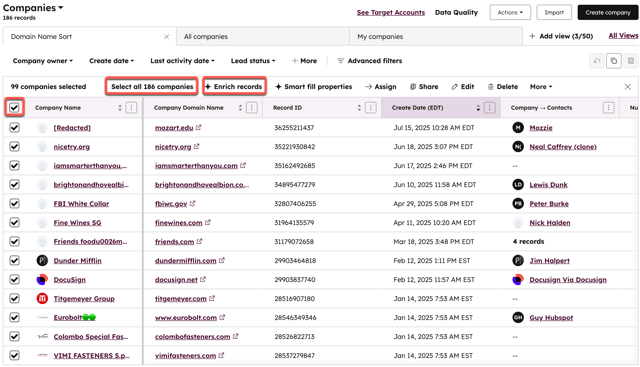
Breeze Intelligence enriches records in bulk: a direct lever on the completeness of critical fields (source: HubSpot).
This is the foundation work we carry out in our SalesOps and Data consulting projects: it is not a detour before AI, it is the path to it.
Where to start: a three-stage path
Our recommendation for organizations discovering Breeze is a simple progression, from the least risky to the most committing.
Stage one: Copilot and Breeze Intelligence. Activate the assistant for your teams and data enrichment. The risk is low (the human stays in the loop at every step), the value is immediate, and usage naturally reveals the weaknesses of your data. It is also an excellent indicator of adoption: a team that does not use Copilot will not use an agent either.
Stage two: one agent on a bounded scope. Choose a use case that is frequent, documented and low-risk for your image (first-level support on standard questions is the typical example). Define the rules for escalation to a human, measure, adjust.
Stage three: managed expansion. Once the first agent is reliable, extend to prospecting or content, keeping at each step an identified human owner and quality indicators, not just volume indicators.
This gradual approach is not excessive caution. It reflects an economic reality: the cost of a poorly framed agent (customers given wrong information, strategic accounts contacted clumsily) far exceeds the expected time savings.
What Breeze will not do for you
An honest article about agentic AI must also say what it does not cover. Breeze will not define your sales strategy, will not decide your segmentation and will not fix a sales process that nobody follows. Agents execute within a framework; if the framework does not exist, they improvise, and large-scale improvisation by an automated system is exactly what you want to avoid.
This is why we approach Breeze projects as RevOps projects before AI projects: scoping use cases, upgrading data, defining governance, then activation. Organizations that reverse the order pay twice: once to activate, once to repair.
Learn more
- SalesOps and Data consulting: the data and governance work that determines the reliability of your agents.
- HubSpot agency: our Elite partner expertise across the entire platform.