[Growth Marketing]
Organic traffic down, AI traffic up: rethinking B2B visibility

Stéphane Duwicquet
Reading time: 7min
30.07.2026

Down 27% in one year. This is the average drop in organic traffic observed across more than 300,000 HubSpot customers worldwide, a figure announced during HubSpot's first-quarter 2026 earnings call, which we analyzed in June with HubSpot's teams during our joint webinar on AEO. Over the same period, 25% of searches worldwide have moved to ChatGPT, Gemini or Perplexity, again according to the data HubSpot presented during the webinar.
Faced with these two figures, most marketing committees draw the wrong conclusion. They see an SEO crisis, launch a technical audit, rewrite tags. They look for a leak in the pipe when it is the river that has changed course.
Our conviction, and the common thread of this article: your falling organic traffic is not an SEO problem, it is a shift in audience. The funnel has inverted. Fewer visits come in, but those that do are worth much more. This reversal changes your KPIs, your content and your organization. In that order.
A quarter of searches have changed their point of entry
Let us break down the 25% figure, because it looks huge and deserves to be understood rather than simply endured. According to the data HubSpot shared during the webinar, there is now roughly one query on LLMs for every two queries on a traditional search engine. And among queries sent to LLMs, about 60% are real searches (the rest is translation, code, writing). The calculation gives a quarter of worldwide searches captured by AI engines.
What should alarm you is not the level. It is the speed. Google took nearly thirty years to structure online search. ChatGPT and its peers captured a quarter of searches in three and a half years, with about 900 million weekly users for ChatGPT in early 2026 and nearly 750 million for Gemini, again according to the figures cited by HubSpot during the webinar. Your buyers are there. The question no longer arises.
And there is something more uncomfortable. On Google, when you lost a position, you saw it in Search Console and could react. On an AI engine, when you are not cited in the first answer, you see it nowhere. The prospect builds their shortlist in a conversation you are not part of, and you lose buyers without even knowing the battle took place. This is the real break: the disappearance of the signal, not just of the click.
The funnel has inverted, and that is good news
The historical model of B2B digital marketing relied on a funnel that was wide at the top: a lot of informational traffic at the top, low but sufficient conversion at the bottom, and a whole nurturing apparatus in between. This model funded fifteen years of content strategies.
It is dying. Not content: the funnel.
Instead, the funnel is inverting: narrower at the top, wider at the bottom. Discovery, comparison and initial screening now happen in the conversation with the LLM, well before the first visit. The visitor who eventually arrives on your site has already done this groundwork: they know your positioning, have compared you with two or three competitors, and come to confirm a choice rather than explore a category.
The figures confirm the intuition: according to HubSpot, traffic from LLMs converts on average 4.4 times better than traditional organic traffic, to the point that the vendor has made it its main indicator of buying intent. Read that sentence again. A company that observes the behavior of more than 300,000 customers considers a visit from ChatGPT its best buying signal, ahead of everything else.
Hence our first position, which some SEO peers will dispute: the traffic that remains is worth more than the traffic lost. Mourning lost sessions means regretting a volume much of which would never have converted. The job is no longer to fill the top of the funnel; it is to be present when the LLM composes its answer, then to be flawless when the highly qualified visitor arrives. Two different disciplines. Two different investments.
The click is no longer the measure of visibility
Here is the consequence almost nobody has yet drawn in their dashboards. Counting only your Google Analytics sessions in 2026 means steering by looking in the rear-view mirror. You precisely measure a channel that is shrinking, and you do not measure at all the channel that decides.
Because your brand can be highly visible without generating a single click. Cited by ChatGPT in a comparative answer, mentioned by Perplexity with a link nobody opens, used by Gemini as a reference in your category: this visibility builds the shortlist, influences the decision, and appears in none of your monthly reports. The click measured visibility when a search ended with a click. This is no longer the case for a quarter of searches.
What we recommend tracking instead, and what we track for ourselves:
- Share of citations: on the questions your buyers actually ask, how often does your brand appear in AI engine answers?
- Share of voice against competitors: being cited 40% of the time means nothing in absolute terms; being cited twice as often as your direct competitor means a lot.
- The origin of citations: does your visibility rely on your own content or on third-party sources you do not control?
- Conversion by traffic source, LLMs included.
(A short aside from experience: the first time a marketing team sees its citation report, the reaction is almost never “we are invisible”. It is “we are visible, but not for the reasons we thought”. That moment is worth all the awareness slides.)
“For fifteen years, we managed visibility by session volume. That counter no longer tells the story: discovery and comparison now happen in AI answers where your analytics see nothing. The KPI that matters is no longer the session, it is the citation and its share of voice against your competitors.”
Let us be clear on one point: we are not saying you should abandon SEO. AI engines rely heavily on indexed content and off-site authority remains a citation factor. We are saying that SEO becomes a necessary condition rather than a sufficient strategy, and that the dashboard must reflect this new hierarchy.
Your content facing 350-word queries
A Google query is 5 words long on average. A ChatGPT prompt is about 350 words long, according to the data presented during the webinar. This gap is not a detail; it reverses the editorial balance of power: with 5 words, the engine guesses the context and favors authority; with 350 words, it knows the context and favors relevance. Generic top-of-funnel content, designed to cast a wide net, is precisely what this new regime crushes.
In practice, the content AI engines cite most, according to the source analysis shared by HubSpot: product pages, blog articles, rankings and comparisons, which account for about 70% of the sources cited. Scannable formats, structured around questions, rich in tables, lists and above all proprietary data. A statistic only you have attracts citations, because the LLM can only reproduce it by mentioning you.
We tested this on our own visibility. Analyzing our citations when the beta of HubSpot's AEO tool launched, we found that around 80% of them came from third-party sources, first and foremost the HubSpot partner directory. Comfortable on the face of it. Fragile in reality: visibility that relies on a single source you do not control is borrowed visibility. So we redefined our target prompts (including by asking the LLMs themselves what questions a buyer would ask), analyzed the competitive landscape of each prompt, optimized an existing pillar page, created a listing-format article and reworked five key articles with FAQs, proprietary data and tables. The result, from our own experience shared during the webinar: our citations on our own media doubled in two to three weeks, and our domain became more cited than our competitors' within this scope.
Two to three weeks. Where SEO is counted in months. This is probably the most underestimated argument for AEO: the feedback loop is short, so learning is fast, so the first-mover advantage is real.
AEO is not a topic for the SEO team alone
The third stage is the one most often ignored. If value shifts from volume to relevance, then content production can no longer be a writing exercise delegated at the end of the chain. The proprietary data that triggers citations sits in your CRM: rates observed among your clients, industry benchmarks, verbatims, win and loss reasons. Using it requires a clean, governed and usable database.
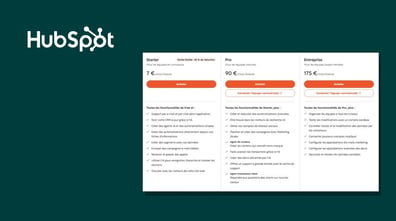
It also requires bringing together teams the org chart keeps apart. SEO stayed confined to acquisition; AEO cuts across acquisition, product, data and brand, because off-site authority (brand awareness, social media, presence in your industry's media) weighs directly on your citations. This is the cross-team work we orchestrate within our growth support, and that we equip on the platform side as an Elite HubSpot agency , in particular through the AEO module now included in Marketing Hub Pro and Enterprise.
One thing has not changed, and it deserves to be said because it is counterintuitive in an article about AI: channel shifts are not new in B2B. The companies that come through them well are those that think in terms of an acquisition system rather than a single dominant channel. The channel changes. The discipline does not.
A final position, which we stand by against those who advocate waiting: waiting for AEO to “stabilize” before investing is the most expensive decision you can make in 2026. SEO in 2004 disproportionately rewarded early movers; SEO in 2015 was a saturated battlefield. AEO is in its 2004. In the cases we see, a few weeks of optimization are still enough to visibly shift a share of citations. This will no longer be true when all your competitors have FAQs and proprietary data on every page.
The question to ask before your next marketing committee
No summary, but an experiment to do tonight; it takes ten minutes. Open ChatGPT and ask it the question your best prospect would ask: “which providers do you recommend for [your category], for a company like [your ICP]?”. Read the answer. Look at who is cited, with which sources, and whether you are there.
If you are there, ask yourself what happens the day the third-party source that carries you disappears from the answer. If you are not, you have just found out where your 27% of traffic went. In both cases, the most important data for your next marketing committee is not in Google Analytics.
FAQ
-
Why is my organic traffic falling while my Google rankings are stable?
Because part of searches no longer go through Google: according to the HubSpot data presented during our joint webinar in June 2026, 25% of searches worldwide now happen on LLMs. Your rankings measure your share of a shrinking pie.
-
Is SEO dead?
No. AI engines heavily cite indexed content and off-site authority remains a factor. SEO becomes the foundation; AEO becomes the challenge.
-
How can I find out whether my brand is cited by ChatGPT or Perplexity?
Manually, by testing your buyers' typical questions on each engine. At scale, with a citation tracking tool: HubSpot offers one, included in Marketing Hub Pro (25 tracked prompts) and Enterprise (50 prompts), which queries ChatGPT, Perplexity and Gemini daily and measures your visibility score and share of voice against your competitors.
-
Can falling traffic really coexist with more leads?
Yes, this is the logic of the inverted funnel: fewer visitors, but visitors already qualified by their conversation with the LLM. HubSpot observes 4.4 times higher conversion on traffic from LLMs compared with traditional organic traffic.
Learn more
- Our growth support: to turn this finding into an acquisition system, from KPIs to content.
- HubSpot Elite agency: to activate the AEO module and align your platform with this new funnel.